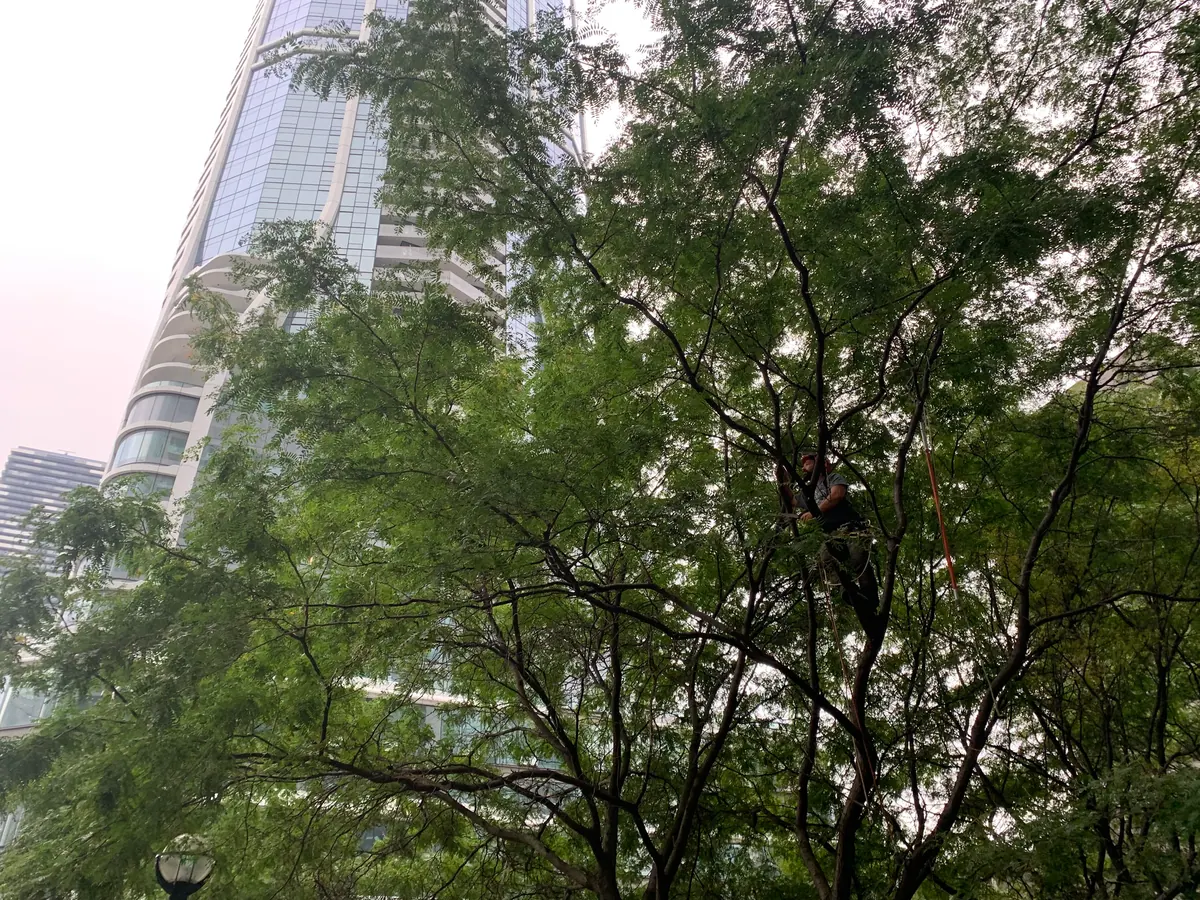
Start by having someone look at them. The most useful storm preparation is removing weak, dead or overextended growth, reducing the wind load on the canopy and supporting any structural weakness with cabling. Doing this before the weather turns is far easier than cleaning up afterward.
Most storm damage to trees does not come from nowhere. A limb that fails in the wind was usually already dead, split or carrying too much weight. That is good news, because it means a lot of storm damage can be prevented.
Not every tree needs work. Some are sound, well formed and sheltered, and the right answer is to leave them alone. The point of a visit is to find out which trees fall into which group, so that the effort goes where it counts. Below we explain what preparation involves, which signs to look for and what to do if a storm has already passed through your property.
Pruning for storm damage preparation
This kind of pruning takes out the parts of a tree most likely to fail: dead branches, broken stubs, crossing limbs that rub and long, heavy branches that reach far from the trunk. It is not about making a tree look neat. It is about shaping the tree so its weight is carried in a way it can handle.
Pruning too much, or cutting in the wrong places, can weaken a tree instead of protecting it. That is why the work should be planned, not improvised.
Wind load reduction and cabling
A dense canopy catches wind like a sail. Wind load reduction selectively thins the canopy so that wind passes through with less force. Cabling is a different tool: it supports a tree that has a structural weakness, such as a split between two main stems or a heavy limb that needs help.
Each of these suits particular trees, and some trees need neither. An arborist can tell you which, if any, makes sense for yours.
Warning signs worth a call
You do not need to be an expert to notice that something is off. Look at your trees on a calm day and check for these signs.
- Dead branches or a canopy that looks thin compared with last season
- Cracks or splits in the trunk or where large limbs join it
- Branches that hang over the house, garage or driveway
- Leaning that is new, or soil lifting at the base
- Mushrooms or soft, crumbling wood on the trunk
Why early is easier
Preparing a tree before the weather turns gives you choices. You can choose the day, the tree can be worked on while it is stable and you can decide calmly what to do. After a storm, the same tree may be split, leaning or tangled with something else, and every option becomes more urgent and more complicated.
There is also the matter of what a failing limb can reach. Branches that overhang a house, a car or a play area deserve attention first. A short visit to look at your trees now can tell you which ones, if any, need work, and which can be left alone.
What to do after a storm
If a tree has been damaged, keep people and vehicles away from it and from anything it may be touching. Broken limbs can hang in the canopy and fall without warning. Call us for a professional opinion on what is safe, what can be saved and what needs to come down.
Green Guard Tree Care is an ISA Certified, Fully Insured arborist based in Caledon Village, and we help with storm damage prevention in North York, Caledon, Orangeville, Brampton, Mississauga, Richmond Hill, Aurora and Newmarket. The sooner a weak tree is looked at, the more options you have.